 Plumbing Advisors Editorial TeamEditorial StandardsSource review July 31, 2026Source-Checked
Size tankless equipment from flow and temperature rise
Continuous hot water still has a capacity limit
Confirm peak flow and temperature rise, then match the model to gas or electrical capacity, venting, water supply, LADBS requirements, and a manufacturer-directed maintenance plan.
Tankless capacity depends on the maximum hot-water flow needed at one time and the temperature rise from incoming water to the desired outlet temperature. The unit, utilities, venting, and distribution system must be planned together.
What to measure before choosing tankless
List simultaneous hot-water uses, the design incoming-water temperature, current pipe runs, and available gas or electrical service. A generic gallons-per-minute claim is not enough to size the home.
| What you notice | What it may indicate | What to do next |
|---|---|---|
| Several hot-water fixtures may run at once | Peak gallons-per-minute demand will control the minimum unit capacity | List simultaneous uses for the Los Angeles sizing calculation rather than adding fixture ratings one at a time. |
| The proposal lists flow but not incoming-water temperature | Required temperature rise may be missing from the sizing decision | Ask for the design inlet temperature, target outlet temperature, and matching model performance table. |
| A gas unit is proposed on the existing gas line | The meter, line, regulator, electricity, and venting may need confirmation | Require the installer to document the utility and vent checks before final equipment selection. |
| An electric whole-home unit is proposed | Panel, service, circuit, and load capacity may affect feasibility | Request a documented electrical-load review and include required upgrades in the bid. |
| The goal is instant hot water at distant fixtures | Pipe length and distribution design still affect delivery time | Compare location and distribution options; a tankless unit alone does not shorten the pipe run. |
Connect sizing, utilities, LADBS scope, and maintenance
DOE guidance requires peak-flow and temperature-rise sizing and review of water, gas, electricity, venting, and distribution. LADBS and LADWP add project and water-quality context without selecting the model for the homeowner.
A whole-home gas model is proposed
Require gas-supply, electricity, combustion-air, venting, water, and current LADBS permit review.
An electric whole-home unit is proposed
Require a documented service, panel, circuit, and load assessment before equipment is ordered.
Hard water is used as the reason to reject tankless
Ask for the selected model's water-quality limits, treatment needs, isolation hardware, and maintenance instructions.
The quote promises instant delivery at distant fixtures
Compare heater location and water-distribution options because pipe length still affects wait time.
LADWP hardness information supports maintenance planning. It does not establish scale inside a particular unit or replace the manufacturer's water-quality requirements.
Sources: Measure Guideline - Transitioning to a Tankless Water Heater, Whole Home Tankless Gas Water Heaters, Water Quality Frequently Asked Questions, Water Heater Permit FAQ, Water Heater Guidance
Check tankless fit for a Los Angeles home
Share peak fixture use, incoming-water assumptions, the proposed unit, gas or electrical capacity, venting path, water supply, and installation location.
No-obligation request · Availability varies by location and provider
What professional tankless installation service does
A tankless water heater delivers continuous hot water and frees up floor space, but a good install depends on the right sizing, venting, and gas or electrical capacity. Plumbing Advisors helps you weigh the tradeoffs and connect with install help.
Professional tankless planning should calculate peak hot-water flow and required temperature rise, then confirm the selected model can deliver both. The review also needs the cold-water supply, gas or electrical service, combustion air and venting where applicable, controls, service access, and distribution path.
A complete installation proposal should identify the exact model and performance table, utility upgrades, venting, piping, condensate handling where applicable, isolation and service provisions, permit responsibility, inspection, startup testing, warranty registration, and maintenance requirements.
What determines whether tankless fits the home
Peak simultaneous flow
Tankless units are rated by hot-water output per minute. Showers, sinks, dishwashers, and laundry that run together must be included in the design demand.
Sources: Measure Guideline - Transitioning to a Tankless Water Heater, Whole Home Tankless Gas Water Heaters
Required temperature rise
The equipment must raise incoming water to the desired outlet temperature while meeting peak flow. The installer should show the inlet assumption and the model performance table used.
Sources: Measure Guideline - Transitioning to a Tankless Water Heater
Gas, electrical, venting, and water capacity
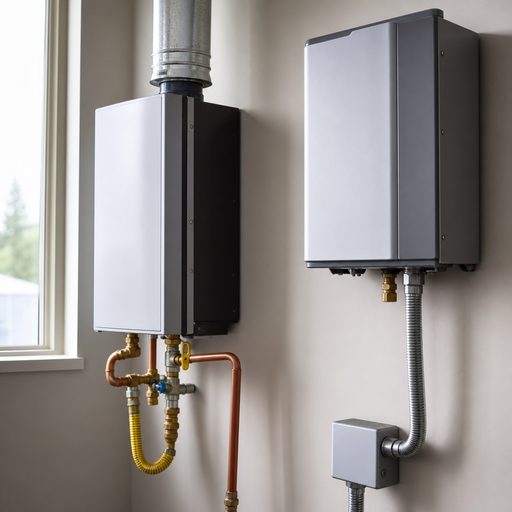
A retrofit may require gas, electrical, venting, or cold-water changes. ENERGY STAR recommends an in-home estimate that checks those conditions before a whole-home gas unit is selected.
Sources: Measure Guideline - Transitioning to a Tankless Water Heater, Whole Home Tankless Gas Water Heaters
Distribution distance and maintenance access
Tankless equipment does not remove the wait created by water traveling through long pipe runs. Location, isolation valves, service clearance, and model-directed scale maintenance belong in the plan.
Sources: Measure Guideline - Transitioning to a Tankless Water Heater
What you can document before the estimate
- List the hot-water fixtures and appliances likely to operate at the same time.
- Photograph the existing heater label, gas meter or electrical-panel service information, and visible installation area without opening equipment.
- Measure accessible room, wall, doorway, and service-clearance dimensions.
- Note the distance from the proposed location to the most frequently used fixtures.
- Leave gas-line sizing, electrical-load calculations, vent design, and water-supply sizing to qualified professionals.
Tankless does not remove hot-water scald risk
The U.S. Consumer Product Safety Commission recommends a residential water-heater setting of 120 degrees Fahrenheit to reduce scald risk. Outlet temperature and controls still require safe setup and testing.
Sources: Avoiding Tap Water Scalds
When the existing heater cannot wait for the conversion
A planned tankless conversion should not delay prompt help for an existing unit that is actively leaking or creating a scald hazard.
- Water is spreading from the current tank or connected piping.
- The existing heater shows active tank leakage with visible corrosion.
- Hot water is unpredictably too hot for safe fixture use.
Sources: Avoiding Tap Water Scalds
How to compare tankless installation paths
Every option should meet the same peak-flow and temperature-rise target. Compare utility and distribution changes alongside the unit rather than treating them as optional extras.
| Method | Where it may fit | Important limitation |
|---|---|---|
| Whole-home gas tankless | The peak flow is defined and the gas supply, electricity, venting, and location support the model | The existing gas line and vent path may not support the proposed input without changes. |
| Whole-home electric tankless | The calculated flow and temperature rise fit a model the electrical service can support | High electrical demand can require panel, service, or circuit work. |
| Point-of-use tankless | A remote fixture or small defined load needs a dedicated local solution | It does not replace a whole-home unit unless every required load is accounted for. |
| Tankless with distribution changes | Long waits or remote fixtures justify evaluating location, piping, or demand-controlled recirculation | A new heater alone does not shorten the water path to each fixture. |
Sources: Measure Guideline - Transitioning to a Tankless Water Heater, Whole Home Tankless Gas Water Heaters
What genuinely changes tankless planning in Los Angeles
Water hardness belongs in the maintenance plan
LADWP says hardness varies across Los Angeles, and DOE explains that scale can restrict a tankless heat exchanger. Use the selected model's limits and maintenance instructions rather than a citywide descaling schedule.
Sources: Water Quality Frequently Asked Questions, Measure Guideline - Transitioning to a Tankless Water Heater
Gas and venting work need project-specific review
ENERGY STAR recommends an in-home check of gas supply, nearby electricity, and combustion venting for a whole-home gas tankless unit. LADBS guidance should then be applied to the selected work.
Sources: Whole Home Tankless Gas Water Heaters, Water Heater Guidance
Do not extend a storage-heater permit exception
LADBS describes a limited equivalent-capacity exception for certain gas water-heater replacements. A tankless conversion changes the equipment and should be checked under the current permit rules for that scope.
Sources: Water Heater Permit FAQ
Comparing a tankless installation estimate
A Los Angeles tankless estimate should separate the unit from gas or electrical upgrades, water piping, venting, condensate, controls, permits, inspection, startup, and finish work.
Scope factors
- Peak flow, temperature rise, model capacity, and equipment type
- Gas meter, line, regulator, electrical service, panel, and circuits
- Cold-water supply, isolation valves, venting, condensate, and controls
- Location, service clearance, pipe-run length, and distribution changes
- Permit, inspection, startup test, warranty registration, and maintenance setup
- Wall, cabinet, platform, paint, or other finish restoration
Questions for the estimate
- What peak flow and temperature rise were used to select this model?
- Which gas, electrical, water, venting, condensate, or control upgrades are included?
- Who obtains the permit and confirms inspection and startup?
- What maintenance access, isolation hardware, and warranty steps are included?
What to tell Plumbing Advisors
Bring the same peak-demand, inlet-temperature, utility, and location assumptions to every installer so the proposals can be compared directly.
- Peak simultaneous hot-water fixtures at the Los Angeles property
- Design incoming-water and target outlet temperatures used for sizing
- Proposed model and its flow-versus-temperature-rise performance table
- Gas meter and line or electrical service, panel, and circuit information
- Cold-water supply, venting, condensate, controls, and service-clearance plan
- Permit, inspection, startup, maintenance, warranty, and excluded upgrade work
Plumbing Advisors does not dispatch its own local technicians. The independent professional is responsible for confirming availability, credentials, diagnosis, price, warranty terms, and work performance.
Tankless Water Heater Installation in Los Angeles: frequently asked questions
How does Los Angeles water hardness affect tankless planning?
It can inform model selection and maintenance planning, but it does not prove scale in a unit. Use the manufacturer limits, site water information, isolation hardware, and service instructions.
Does a Los Angeles tankless conversion use the gas storage-heater permit exception?
Do not assume so. LADBS describes a narrow equivalent-capacity gas replacement path. Tankless equipment can change input, venting, utilities, water, and project classification.
What utility checks belong in a Los Angeles gas tankless quote?
The installer should document gas-line capacity, nearby electricity, combustion venting, cold-water supply, model output, service access, and required approvals.
Will tankless make hot water arrive instantly at every fixture?
Not necessarily. DOE notes that location and the existing distribution path affect delivery time. Compare pipe length, placement, and appropriate demand-controlled distribution options.
Sources and editorial methodology
Sources are included when they substantively support a local, safety, technical, or consumer decision on this page.
- DOE, ENERGY STAR, LADWP, LADBS, and CPSC sources support tankless sizing, utilities, venting, water-quality limits, permit boundaries, and safety.
- Water hardness informs maintenance planning but is not treated as proof of equipment condition or a fixed service schedule.
U.S. Consumer Product Safety Commission
Avoiding Tap Water ScaldsU.S. Department of Energy
Measure Guideline - Transitioning to a Tankless Water HeaterENERGY STAR
Whole Home Tankless Gas Water HeatersLos Angeles Department of Water and Power
Water Quality Frequently Asked QuestionsLos Angeles Department of Building and Safety
Water Heater Permit FAQLos Angeles Department of Building and Safety
Water Heater Guidance