 Plumbing Advisors Editorial TeamEditorial StandardsSource review July 26, 2026Source-Checked
Start with the evidence before choosing the scope
Cleaning, inspection, or repair?
A Miami sewer camera inspection should answer a private-line question after the active backup and wet-weather context are documented. Floodwater and heavy rain can affect wastewater systems, but they do not prove a defect at the property; require a complete video, measured finding, and written interpretation.
This framework helps organize the request; it does not diagnose a buried line. Stop household water use and avoid contact when wastewater is entering the home.
What the sewer pattern or finding may mean
Recurring symptoms can justify wider assessment, but a repair or replacement decision should be tied to a located condition and documented findings.
| What you notice | What it may indicate | What to do next |
|---|---|---|
| Several fixtures back up during flooding or heavy rain | Wet-weather wastewater conditions may be involved while the private line remains unconfirmed | Stop adding water, avoid contact, record the timing, and report flooding through 311 when applicable. |
| The same shared line clogs during dry weather | A recurring obstruction or private-line condition may be contributing | Ask whether clearing is needed before a camera can document the pipe. |
| The camera view is blocked by material | The line may not yet be visible enough for condition assessment | Separate clearing from inspection and request post-cleaning footage. |
| A visible condition appears at one location | The finding may support a targeted next step | Ask for orientation, measured location, the complete recording, and written findings. |
| Repair is proposed from rain timing alone | System context is being treated as a property diagnosis | Require direct private-line evidence before comparing repair or replacement. |
Separate Miami wet-weather context from private camera findings
Local guidance notes that floodwater can enter the sanitary sewer system and advises limiting household water use after storms. Those facts explain safe response and reporting, not the condition of one property's line.
Floodwater or heavy rain coincides with the backup
Limit water use, document the event, and report flooding through 311 when applicable.
Symptoms continue after the wet-weather event
List the affected fixtures and define the private-line question for inspection.
The line must be cleared for visibility
Keep cleaning and camera inspection as separate scopes and request the post-cleaning view.
The camera shows a possible defect
Request the full video, orientation, measurement, and written observed-condition summary.
Rainfall, flooding, and city location are context, not proof of a private obstruction or defect. The camera result must stand on property-specific evidence.
Sources: Heavy Rain, Hurricane Season Readiness, Sewer Pipe Assessment
Get help with a sewer camera inspection problem in Miami
Describe the affected fixtures, recurrence history, and any camera video or written findings already available.
No-obligation request · Availability varies by location and provider
What professional sewer camera inspection service does
A sewer camera inspection lets a plumbing professional see inside your line and find the real cause of a problem before any work begins. Plumbing Advisors helps you understand when an inspection makes sense and connect with help near you.
Sewer service begins by defining the affected line and the question the visit needs to answer. Restoring flow, documenting pipe condition, repairing one defect, and replacing a run are different scopes.
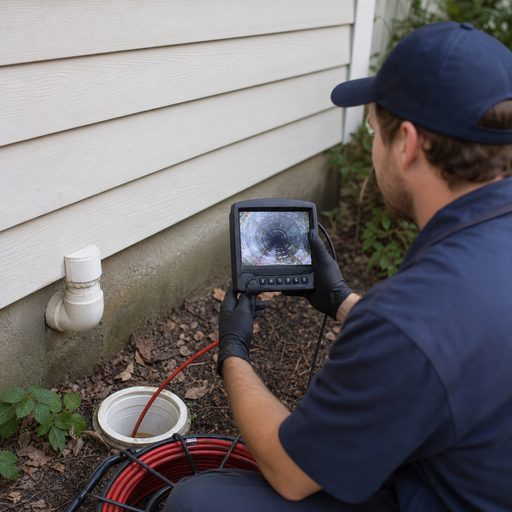
A camera can show visible conditions inside an accessible line, but the recording still needs interpretation and a known location. It does not by itself prove the cause of every symptom or authorize a particular repair.
Why sewer symptoms can return after clearing
A remaining or recurring obstruction
Grease, wipes, debris, and other material can restrict a line again when the original obstruction was only partly opened or the contributing use continues.
Roots entering an opening or defect
Roots can enter a sewer line through an opening and catch debris. Nearby trees alone do not prove root intrusion; the line needs supporting findings.
A structural or alignment condition
Cracks, displaced joints, deformation, or another visible condition may affect flow. The finding, location, and extent matter when comparing a spot repair with replacement.
Sources: Sewer Pipe Assessment
A capacity or public-system condition
Wet weather, infiltration, power loss, or a public-system problem can contribute to a backup. Private repair should not be presented as the answer until the responsibility and line condition are understood.
Sources: Sanitary Sewer Overflows, Sanitary Sewer Overflow Frequent Questions
What you can safely document first
- List every affected fixture and identify the lowest drain involved.
- Note whether the problem occurs in dry weather, during rain, or under normal household use.
- Save prior camera video, service notes, invoices, and written condition findings.
- Stop using fixtures when another drain rises or wastewater enters the home.
- Do not enter wastewater, open an unsafe cleanout, excavate a line, or reach into a sewer opening.
Keep sewer wastewater and openings off limits
Untreated sewage can threaten health and damage property. Keep people and pets away, avoid direct contact, and leave cleanout opening, excavation, and pressurized work to qualified professionals with safe access.
Sources: Sanitary Sewer Overflows, Sanitary Sewer Overflow Frequent Questions
When a sewer problem is urgent
Do not delay safe response for camera scheduling when wastewater is entering the home. Stop household water use, keep away from contaminated water, and report flood-related wastewater conditions when applicable.
- Raw wastewater is visible at a shower, floor drain, tub, or toilet.
- Using one fixture raises another low drain.
- Floodwater or sewage is spreading into occupied areas.
- Essential fixtures cannot be used without another overflow.
Sources: Sanitary Sewer Overflows, Sanitary Sewer Overflow Frequent Questions, Hurricane Season Readiness
How inspection, cleaning, repair, and replacement differ
The next method should answer the unresolved question. A recurring blockage can justify inspection, but repair extent should follow a located condition rather than the service name alone.
| Method | Where it may fit | Important limitation |
|---|---|---|
| Camera inspection | Locating visible conditions after recurrence or shared-line symptoms | The recording needs orientation and interpretation and may not show every external condition. |
| Mechanical or water-based cleaning | Removing an accessible obstruction or buildup when pipe condition supports the method | Restored flow does not prove the line is structurally sound. |
| Targeted repair | A defined defect with a repairable location and limited extent | The estimate should identify the defect, access route, repair limits, and testing. |
| Line replacement | Widespread failure or conditions that cannot be reasonably addressed with a limited repair | Replacement should not be inferred from age, city, roots, or one camera still image alone. |
Sources: Sewer Pipe Assessment
What genuinely changes the sewer decision in Miami
Floodwater can affect the sanitary sewer system
Miami-Dade guidance says floodwater can inundate sanitary sewers and recommends limiting household water use after storms. Record that context, but do not use it as proof of a defect at the home.
Sources: Hurricane Season Readiness
Inspection evidence needs orientation and location
A camera assessment is most useful when the recording identifies the inspected line, access point, direction, distance, and visible condition. A selected still image does not represent the entire accessible line.
Sources: Sewer Pipe Assessment
FOG is a preventable obstruction category, not a diagnosis
Local utility guidance says fats, oils, and grease can adhere to pipe walls and contribute to backups. A camera or clearing finding is still needed before assigning that cause to a specific property.
Sources: Fats, Oils and Grease
Comparing a sewer camera inspection estimate
A Miami camera estimate should identify the inspected line, access point, clearing prerequisite, locating work, and delivered records. Any repair proposal should remain separate until findings support it.
Scope factors
- The line, access point, and inspection length
- Whether clearing is required before viewing
- Video, narration, measurement, and written-report deliverables
- Whether electronic locating is included
- Whether a separate findings review is included
Questions for the estimate
- Which line and access point will be inspected?
- What happens if the camera cannot pass?
- Will I receive the complete video and written findings?
- Will any repair proposal be quoted separately after review?
What to tell Plumbing Advisors
A useful sewer request includes the symptom pattern and any existing evidence without turning either into a remote diagnosis.
- Record whether symptoms began during rain, flooding, or dry weather.
- List every affected fixture and any prior clearing or repair work.
- Save a 311 request number when flooding was reported.
- Ask which line and access point the camera will use.
- Request the complete video, measured locations, narration, and written findings.
Plumbing Advisors does not dispatch its own local technicians. The independent professional is responsible for confirming availability, credentials, diagnosis, price, warranty terms, and work performance.
Sewer Camera Inspection in Miami: frequently asked questions
Does a Miami backup during heavy rain prove my sewer line is damaged?
No. Floodwater and wet-weather wastewater conditions can provide context, but the private line needs its own inspection or clearing evidence before a defect is assigned.
What should a Miami sewer camera inspection include?
Ask for the identified line and access point, complete video, direction, measured locations, narration, and a written summary of observed conditions.
Can grease be identified from the address or neighborhood?
No. Local guidance identifies fats, oils, and grease as a preventable cause of buildup, but a specific line still needs direct findings.
When should I report a Miami wastewater problem through 311?
Local storm-readiness guidance directs residents to report flooding through 311. Preserve that report alongside any private inspection record.
Sources and editorial methodology
Sources are included when they substantively support a local, safety, technical, or consumer decision on this page.
- Miami wet-weather facts are used for response and reporting context, not a property diagnosis.
- Camera claims are limited to visible, accessible conditions with orientation and location.
- FOG prevention guidance is not used to claim that a specific line contains grease.
Miami-Dade County
Fats, Oils and GreaseMiami-Dade County
Heavy RainMiami-Dade County Water and Sewer Department
Hurricane Season ReadinessU.S. Environmental Protection Agency
Sanitary Sewer Overflow Frequent QuestionsU.S. Environmental Protection Agency
Sanitary Sewer OverflowsNational Association of Sewer Service Companies
Sewer Pipe Assessment