 Plumbing Advisors Editorial TeamEditorial StandardsUpdated May 6, 2026Source-Checked
Before you call anyone about a suspected leak, there is one safe, free check that can tell you whether water is actually escaping somewhere in your home: a water meter test. Your meter measures every drop that enters the house, so if it keeps moving while nothing is running, water is going somewhere it should not. This test will not tell you where the leak is hiding, but it reliably confirms that a leak exists, which is exactly the kind of information that helps you decide whether to bring in a professional. Done carefully, it takes only a couple of hours of patience.
Before You Begin
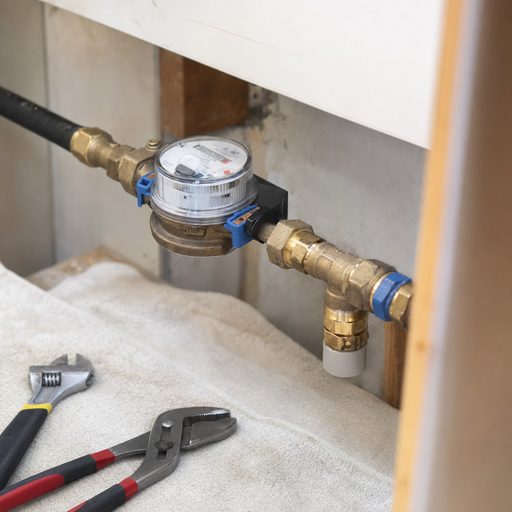
The test only works if absolutely no water is being used during the waiting period, so a little preparation goes a long way. Plan to run it at a time when the household can go an hour or two without touching a tap, and make sure automatic water users will not switch on mid-test and spoil the result. Take a moment to locate your meter first, which is usually in a covered box near the street or, in some homes, in a basement or utility area.
- Turn off every faucet, shower, and tub in the home.
- Make sure the dishwasher and washing machine are not running.
- Pause any automatic systems such as ice makers, irrigation, and water softeners that cycle on their own.
- Hold off on flushing toilets for the duration of the test.
- Let everyone in the household know not to use water until you are done.
Running the Test
With all water off, find your meter and look at it closely. Many meters have a small dial or triangular indicator that spins even when only a tiny amount of water is flowing; if that indicator is moving while everything is shut off, that alone strongly suggests a leak. For a clearer result, write down the exact meter reading, then wait one to two hours without using any water at all. Return and read the meter again. If the number has changed, water moved through your system during a time when nothing should have been running, which points to a leak somewhere in the home. If the reading held perfectly steady, an active supply-side leak is unlikely.
Narrow it to indoors or outdoors
If your home has a shutoff valve where the main line enters the house, you can repeat the test with that valve closed. If the meter stops moving once the house is isolated, the leak is likely on the indoor side; if it keeps moving, the leak may be in the line between the meter and the house.
What the Result Tells You
A meter that moves during the test is solid evidence that water is escaping, but remember what the test cannot do: it will not reveal whether the leak is in a wall, under a slab, or out in the yard, and it mainly catches pressurized supply-side leaks rather than drain leaks that only run when a fixture is in use. A steady meter is reassuring, though it does not completely rule out an intermittent or drain-side problem. Either way, the result is genuinely useful. Knowing a leak is present, and roughly whether it is indoors or out, gives a professional a strong head start and can make the detection visit quicker.
When to Call a Professional
If your meter test confirms a leak, the safe next move is to bring in help rather than start opening walls or digging, since guessing at the location tends to cause damage without finding the source. Leak detection service uses specialized tools to pinpoint the leak without unnecessary demolition, and pipe repair can fix an accessible line once it is located. Sharing your test results, including whether the meter moved with the house isolated, gives the plumber a useful starting point. To make sense of the clues that prompted the test in the first place, see our guide on the subtle signs of a hidden water leak, and once the source is found, what happens after a leak is found walks through the repair decisions ahead.
Sources and further reading
These references support material safety, technical, consumer, or planning guidance in this article. Confirm property-specific requirements with the applicable authority and professional.
- U.S. EPA WaterSense - Home maintenance
- U.S. EPA WaterSense - Fix a Leak Week
- MedlinePlus - Drain cleaner poisoning
- U.S. EPA - Household hazardous waste
- National Association of Insurance Commissioners - Homeowners insurance
- National Association of Insurance Commissioners - Burst-pipe water damage
- Federal Trade Commission - Avoiding home-improvement scams